Towards a More American Classical Education
As America is celebrating its 250th Anniversary, an important debate is unfolding across the educational landscape, from K-12 schools to universities, and especially within the growing classical education movement.
Should education focus primarily on the Liberal Arts? Or should it focus on workforce preparation?
For many parents today, the term Liberal Arts carries a negative connotation. Too often, families associate it with expensive college degrees, political indoctrination, and graduates burdened with debt while struggling to find meaningful work. Parents are understandably asking practical questions:
Will my child be able to earn a living?
Will they develop useful skills?
Will education prepare them for the real world?
In response, a growing movement argues that schools should focus almost exclusively on workforce skills, technology, trades, and career readiness.
But perhaps this is a false choice.
What if students could receive a true liberal arts education—the kind that teaches critical thinking, wisdom, communication, problem-solving, discernment, creativity, and strong moral character—while also developing the practical skills needed to thrive in a rapidly changing technological economy?
Historically, America has excelled at combining these very strengths.
The American branch of the Western tradition has long recognized the dignity of all vocations: pastors, statesmen, entrepreneurs, engineers, farmers, craftsmen, laborers, and business leaders alike. As Gene Edward Veith has observed, Protestant classical education affirms the spiritual value of everyday work. Shop class, after all, can be soulcraft.
That is one reason I found the following article especially thought-provoking. It challenges classical educators to avoid becoming detached from the practical realities of modern life and instead cultivate leaders capable of building, innovating, financing, and sustaining strong institutions.
One paragraph especially stood out to me:
“If Christians wish to form a classically-trained elite of our own, we will need to graduate innovative leaders in the trades, technology, and business who can finance it.”
That question seems particularly timely as America reflects on both its past and its future.
~ Danita Bye
Danita Bye is a Leadership Futurist, Author, and Founding Board Member of Christian Crossroads Academy. She’s committed to restoring virtue-centered formation in education. Her work focuses on empowering leaders in an age of rapid technological change, where wisdom and discernment matter more than ever.
She partners with Christian leaders across education, business, and civic life who believe character ultimately determines impact. Danita serves on many boards in North Dakota and nationally that are focused on leadership and ethics. She is the author of Millennials Matter and the forthcoming Character Mandate, and a TEDx speaker passionate about forming leaders rooted in truth, courage, and faith.
Danita has a master’s in transformational leadership from Bethel University, MN. She currently lives near the TTT Ranch, in Stanley, North Dakota, where she grew up. She’s been married for 42 years and has six grandchildren.
__________________________________
Publication: American Reformer
Author: Nathan Gill
Date: February 19, 2024
You can read the original article HERE
Classical Education at a Crossroads
The movement to resurrect classical, Christian education has flourished beyond what many of us thought possible. Its graduates have shown what can be done with a little piety, imagination, and the daring to trust that Providence works through tradition.
But in many important respects, the movement now stands at a crossroads.
Latent tensions are fast coming to the surface, as American Reformer has repeatedly warned. At stake is the future faithfulness of American classical schools, especially as they plunge deeper into the pressures of the “negative world.” What does it mean to be “classical”? What exactly is the “Western canon?” To what extent should classical schools embrace “elitism?”
The way these questions are answered will set the future trajectory of the movement, for better or for worse. And, for all the excellent answers that have been given, I would suggest one of the most important is often least talked about in the wider Protestant world: the need for a classical education that is more intentionally American – that is, one that more deeply roots students in the specifically American branch of the Western tradition and prepares them to “face the conditions of modernity” in the modern American context.
America and the Canon Wars
The need for clearer emphasis on the American ends of classical schools became glaringly evident when last year’s debate about the CLT author bank exposed how much disagreement lurks beneath classical educators’ unity around “the Western canon.”
There are many problems with the way Jessica Hooten Wilson argued for an “assortment of voices” in classical curricula, but she did expose how platitudinous “classical” lingo can become. It’s not as simple as selecting “Great Books” that are “excellent,” or that embody “truth, goodness, and beauty.” They all fit that bill. The next question we must ask is, what standard do we use to choose among these? “Good, true, and beautiful,” to what end? “Excellent” for whom?
Without a concrete standard, even well-meaning schools will end up defaulting (like Wilson) to thinly veiled versions of our cultural shibboleths: that we should define the canon and select texts from it to promote some form of “equality” and “inclusion.”
Many otherwise sound responses to Wilson left this vacuum unfilled until Lue-Yee Tsang pointed out that classical education has “civilizational boundaries.” All classical schools are part of a particular nation, and that simple fact dictates what part of the classical tradition they should emphasize. American classical schools must ask what “excellent” and “beautiful” Western texts, arts, and skills will form virtuous Americans.
Compare John Senior’s famous list of “good books” with the curricula of many modern classical schools. To be sure, classical schools have put a great deal of thought into forming good citizens. But, if faced with the choice, how many seriously consider reading James Fenimore Cooper over, say, Charles Dickens? How many graduates can talk as intelligently about the early republic’s Protestant establishment as about the Investiture Controversy, or about the great Winslow Homer as about Vermeer? How many “integrated” humanities programs teach American history in the depth needed in an age where existential questions abound?
Entrepreneurialism and the Trades
Classical schools that are more intentionally American will also better prepare students for the realities of modern American economic and political life. As Aaron Renn reminds us, “facing the conditions of modernity” requires more than the Great Books.
It’s a well-known fact at top-tier conservative colleges that too many graduates of classical programs, habituated to prefer the “contemplative life,” end up being essentially boxed into teaching careers – many of them low-paying. They then face a choice between a job they’re equipped for and the ability to provide for their families adequately. This was the experience of many graduates I’ve personally known; it’s a trend other influential figures in the classical world have warned about as well.
Overly abstract slogans may again be to blame here. If by “education for its own sake” we mean ordering students’ affections so that they love “the kingdom of God and his righteousness” more than exam grades and paychecks, all well and good. But if it leads us to subtly deemphasize the incarnational duties of work, entrepreneurialism, and citizenship, we do our students a profound disservice. Classical graduates will need more entrepreneurial and practical skills than ever to prudently navigate the negative world, maintain productive households, pursue ownership, and build new institutions.
The American branch of the Western tradition has long excelled at imparting these very skills. Herein lies much of our nation’s unique wisdom. As Gene Edward Veith has reminded us, this is because Protestant classical education acknowledges the spiritual dignity of all vocations, whether that of the pastor, the statesman, the farmer, laborer, or businessman. Shop class, after all, is soulcraft. And while there are many encouraging signs that the classical world is waking up to this truth, any lasting reform will be led by Protestant George Baileys, who can stand in the broad stream of the American tradition and resist the ascetic temptations of this negative world.
A pragmatic note on this point: if Christians wish to form a classically-trained elite of our own, we will need to graduate innovative leaders in the trades, technology, and business who can finance it. There is no other way to form and sustain a network of elite institutions but through the skills of a classically-minded entrepreneurial class.
Shaping American Affections
Finally, all of these proposals require students who are thoroughly steeped in the United States’ past, invested in its future, and capable of intelligently and strategically sacrificing for its good – the good of our fellow citizens. In other words, it requires a classical education that is as unapologetic about “shaping affections” for our nation as for the Church and the family.
Nor can this be dismissed as jingoism. St. Thomas Aquinas himself argued that “after God,” one owes “worship” chiefly “to one’s parents and one’s country.” The Reformers followed suit.
And yet how many modern leaders in the classical renewal would be comfortable talking this way? Instead, under the spell of a reductionistic view of classical education, too many boast about “teaching students how to think, not what to think” – as if education is a value-neutral enterprise to produce students who love all principles, nations and ideas equally. Classical students, according to one prominent organization, “learn the absolute value of these American ideals and then choose for themselves whether they will commit themselves to them or reject them.” This same logic is not applied to how schools teach Christianity, or Christian parents would (understandably) reconsider where to invest their money.
The good news is that most classical educators do an excellent job emphasizing how important habits, “liturgies,” and beauty are in forming love for what is worth loving. They simply need to have the boldness to extend this logic.
The early republic modeled this extremely well. Founding Father Benjamin Rush insisted that public schools should not view students as “perfect blanks,” but should habituate them towards love for their nation (for “patriotism needs the reinforcement of prejudice”) and for the Christian religion. One of the most important Antebellum textbooks hymned the “sacred associations” of the American landscape and warned that “young affections…must be bound to them or they must cease to be…the inheritance and abode of a free people.” The brilliant Thomas Cole (a devout and orthodox Protestant) pioneered the Hudson River School of landscape painting to inspire love for the beauty of the American landscape and the temperance necessary for self-government. New England educators used American Greek Revival architecture to form patriotic students with republican virtues, and plotted school grounds that would surround children with the beauties of native plants and trees.
Classical schools would do well to learn from this part of our tradition and use aesthetics, liturgy, and curricula to boldly shape students whose devotion to their national family is exceeded only by their devotion to their faith.
Conclusion
The next few years will be a critical period for the classical movement in the United States. As our schools emerge onto the radar of the negative world, hostile press will increase, as will the temptation to save face by compromising everything our movement gets right: our commitment to Christianity, our national heritage, and the wisdom of the liberal arts and the Western canon.
Standing firm amid the coming storm will require many things from classical schools – stauncher faith, thoroughgoing denominational identity, a better understanding of the liberal arts, etc.
But in pursuing these goals, we should remember Aristotle’s wisdom: the national community embraces, in some important respect, the “goods” of all other communities, including our churches and schools. By situating our classical schools more clearly within our national context, past and present, we can be more faithful to our own inheritance, “remember” how to pass it on to our children, and “resist false paths.”
Far from making education subservient to earthly aims, a more American classical education will help us orient our incarnational lives as citizens to our faith. This is not only more Christian and American, but also profoundly classical: Aristotle argues in Book VIII of his Politics that education must be ordered towards the nation, not only for political ends, but because the “good life” individuals seek is only attainable within a civic and national context. This is an attitude classical education in America must recover if it is to continue going “from strength to strength” in the years that lie ahead.
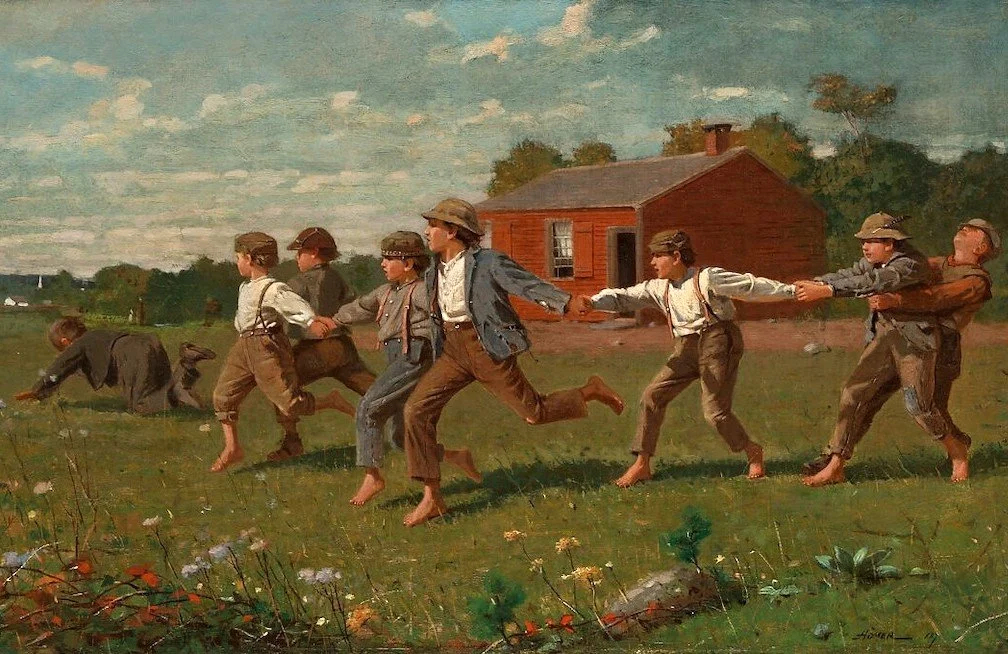
Image Credit: Winslow, Homer Snap the Whip 1872 Oil on Canvas, Butler Institute of American Art, Youngstown OH