
There Is No Neutral - The Conversation That Changes Our View of Education
My dad, Fred Evans, does not wake up one morning planning to start a school.
In fact, when he comes home in October 2024 and announces that we are launching a classical Christian academy in Stanley, the rest of us look at him with some shock. We know zero about starting a school. We are business leaders, not educators. We know families are interested in educational options. That does not mean we are ready to build one.
Everything changes because of a lunch conversation.
My parents meet with Dr. Mark Pearson, president of Liberty Resources. They work together during the explosive growth of the Bakken. At that lunch, my mom asks a simple question about Mark’s family. That question opens the door to something deeper.
Mark begins sharing about a recent decision his family makes. They switch their children to a classical Christian school. What stands out is not frustration. It is enthusiasm.
In the Age of AI, where we find ourselves right now, this is a turning point.
Somewhere in the middle of that lunch conversation, the tone shifts.
Mark does not speak as an educator or policy expert. He speaks as a father. He describes moments that catch him off guard. His son’s oil and gas project is quietly dismissed because the teacher wants to highlight renewable energy. In another class, lessons regularly end with the conclusion that the answer to social problems is simply “raise taxes and grow government.” In biology, students are told that gender is fluid and self-defined.
At first, Mark and his wife believe a non-religious private school will remain neutral. “We think it is fine,” he says. “They can get their faith at church. School will just handle academics.”
He begins to realize something deeper: there is no such thing as neutral. Every school teaches a worldview. Every subject points somewhere. (To hear Mark’s parent story, scroll down on this page - https://christiancrossroadsacademy.org/events)
That realization becomes the turning point. Not anger. Not panic. Clarity.
That clarity changes everything.
Learning What We Do Not Know
After that conversation, our family begins learning.
Through what we can only describe as God’s provision, we connect with Brandon Strong, headmaster at Barry County Classical Christian School in Michigan. Brandon generously travels to Stanley to help us understand what classical Christian education truly is.
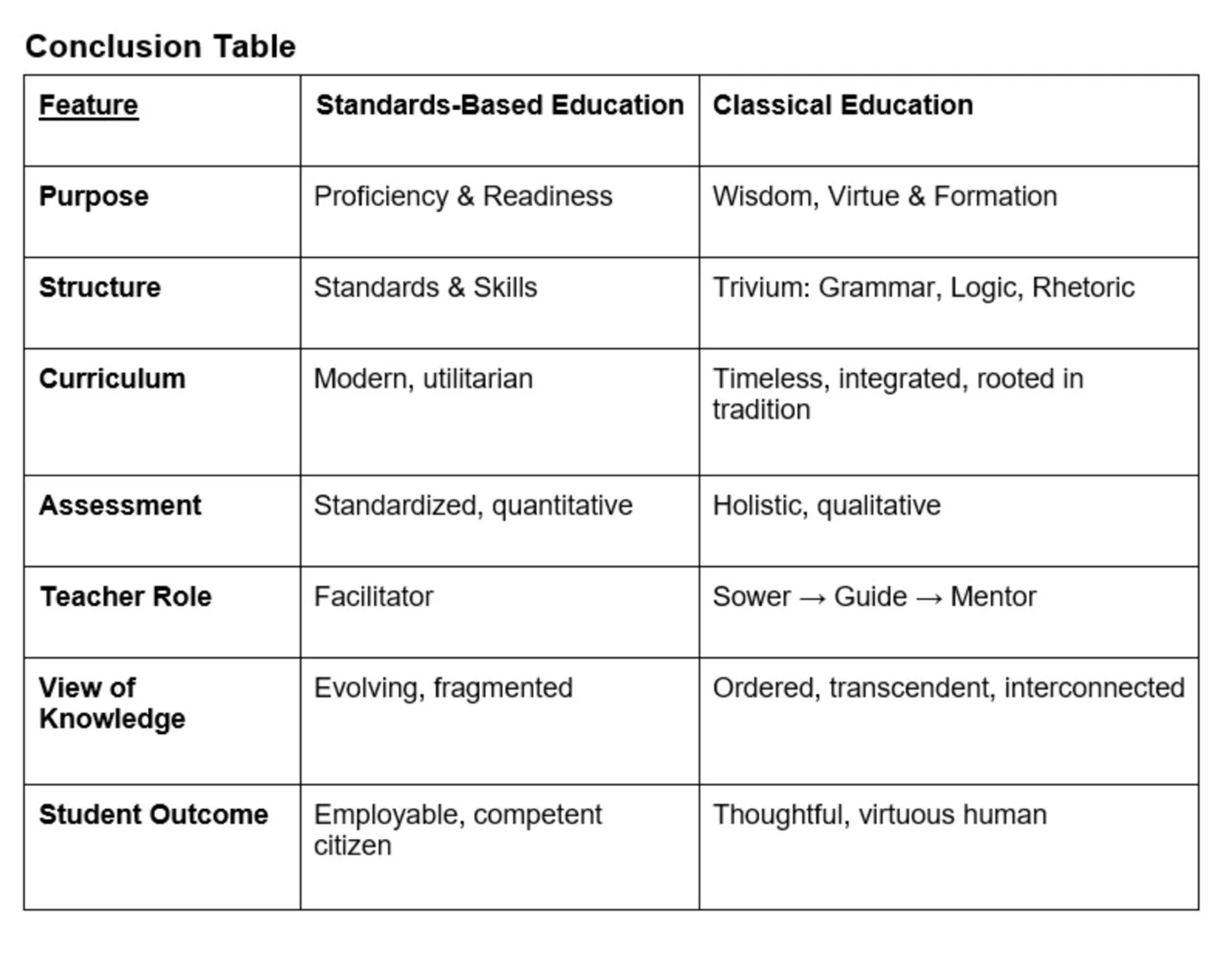
One of the most helpful tools he gives us is a simple side-by-side comparison between standards-based education and classical education. It helps us see the difference clearly. Read the article Modern Standards-Based Education vs Classical Education.
The Foundation Matters
Standards-based education, which most of us grew up with, is rooted in progressivism and behaviorism. It focuses on measurable outcomes, state benchmarks, and career readiness. It aims to produce competent students who meet standards.
Classical Christian education is rooted in the Western tradition and a biblical worldview. It aims to form the whole person: mind, body, and soul. It seeks wisdom, virtue, and a love for truth, goodness, and beauty.
One model asks, “Did you meet the standard?”
The other asks, “Who are you becoming?”
That difference is significant.
Structure That Builds Depth
Standards-based systems organize learning by grade-level standards and performance metrics. The focus is often breadth. Students move quickly from one unit to the next.
Classical education follows the Trivium:
• Grammar stage (K–6): students build foundations through memory work, language, math facts, Scripture, and great stories.
• Logic stage (7–9): students learn to think critically, ask good questions, and reason carefully.
• Rhetoric stage (10–12): students learn to speak and write persuasively with clarity and character.
Instead of racing through material, students go deep. They study classical literature, formal logic, Latin, philosophy, and theology. Subjects connect rather than sitting in isolated boxes.
A Different View of the Child
In standards-based systems, students are often seen as learners progressing through benchmarks. Data drives instruction.
In classical Christian education, students are souls to be cultivated. Education shapes intellect, character, affections, and habits.
Academics are not weaker in this model. Academics serve formation.
Teachers as Sowers, Guides, and Mentors
In many modern systems, teachers function as facilitators who follow prescribed curriculum tied to testing.
In classical education, teachers serve as:
• Sowers in the grammar stage, planting seeds of truth.
• Guides in the logic stage, leading thoughtful reasoning.
• Mentors in the rhetoric stage, modeling wisdom and leadership.
The teacher’s character matters. Their example matters.
The Goal Is Different
Standards-based education often focuses on producing college- and career-ready graduates with 21st-century skills.
Classical Christian education seeks something deeper. It seeks students who love learning, pursue truth, and live virtuous lives under God’s authority.
Education becomes a lifelong journey of becoming more fully human.
We do not start this journey because we think we are experts. We start because we see families asking for something more grounded. We see parents who want their children formed, not just measured.
Mark’s clarity becomes our catalyst.
What begins as a lunch conversation becomes a calling.
If you are curious about what classical Christian education could mean for your family, we invite you to learn more about Christian Crossroads Academy. We continue learning. We continue building. We believe this model offers something timeless in a world that feels anything but stable.
Danita Bye
Danita Bye is a Leadership Futurist, Author, and Founding Board Member of Christian Crossroads Academy. She’s committed to restoring virtue-centered formation in education. Her work focuses on empowering leaders in an age of rapid technological change, where wisdom and discernment matter more than ever.
She partners with Christian leaders across education, business, and civic life who believe character ultimately determines impact. Danita serves on many boards in North Dakota and nationally that are focused on leadership and ethics. She is the author of Millennials Matter and the forthcoming Character Mandate, and a TEDx speaker passionate about forming leaders rooted in truth, courage, and faith.
Danita has a master’s in transformational leadership from Bethel University, MN. She currently lives near the TTT Ranch, in Stanley, North Dakota, where she grew up. She’s been married for 42 years and has six grandchildren.