A Letter to My Students About AI and Homework

Introduction
Artificial Intelligence has arrived in our classrooms faster than any of us expected. Educators from kindergarten through higher education are asking how to use it well. Universities are launching AI learning centers. Valley City State University, for example, recently established an AI Institute for Teaching and Learning to help position teachers and students at the forefront of innovation. The momentum is undeniable.
Students are asking questions too. My third-grade grandson was recently assigned a research project on lions. His first instinct for help? ChatGPT. That moment made me pause. When the helper is always available, always instant, and always articulate, what happens to the slow work of thinking?
In the classical Christian model, we believe education is not simply about completing assignments. It is about forming the student. Homework is not busywork. It is training. It builds attention, endurance, reasoning, and clarity of expression. The struggle to write a paragraph or solve a problem is not a flaw in the system. It is the point.
That is why this article, A Letter to My Students About AI and Homework by Jason Farley, resonated so deeply with me. It reminds us that the goal is not the finished paper. The goal is the formation of the writer.
In an age of powerful tools, we must ask a deeper question: How do we form strong minds and faithful thinkers?
Danita Bye
Publication: Concordis Education Partners
Author: Jason Farley
A Letter to My Students About AI and Homework
"To [my father], all good things – trout as well as eternal salvation – come by grace; and grace comes by art; and art does not come easy.”– Norman Maclean, A River Runs Through It
There is a scene in “A River Runs Through It” that I’ve shown to writing students for years. The Rev. Maclean assigns his son a paper. The boy turns it in. The father marks it up and says, “Half as long.” The son rewrites it. The father marks it up and says. “Again. Half as long.” The son brings back one more draft. The father reads it and says, “Good. Now throw it away.”
It feels harsh at first. But the School of the Rev. Maclean is not about getting a good paper. He is shaping a mind, sharpening a pen, forming a clear-eyed soul.
That’s why I give you schoolwork.
Why don’t athletes bring robots to the weight room? Because the purpose of lifting weights is not to get the weights up. It’s to build muscle for the game.
The worksheet, essay, or problem set is never the point. The goal is to strengthen attention, deepen understanding, build endurance, exercise the memory, practice your skills, and sharpen your mind. The strain you feel when wrestling with a paragraph, struggling through a math problem, or revising a draft, that strain is how strength grows. A math problem wrestled with and answered wrong is more valuable than a right answer supplied by AI.
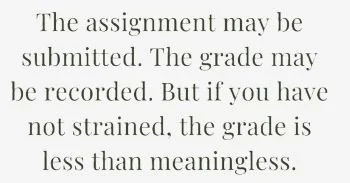
Artificial Intelligence is a powerful tool. (AI is checking my grammar and spelling as I write this now). Used wisely, it'll be a real blessing. But when it replaces your own thinking, it removes the resistance your mind needs to grow. This is how you grow into someone who can use these tools well. The assignment may be submitted. The grade may be recorded. But if you have not strained, the grade is less than meaningless. Always remember, the grade is not the point.
Consistently avoiding struggle through AI will make you mentally weak. Life is not gentle with mental weakness.
Life demands strength and clarity of mind.
The Rev. Maclean in “A River Runs Through It” is not punishing his son with each "Again". His hope is simply insistent. He believes strength and beauty are hard-won in disciplined toil. Years later, that discipline becomes the luminous prose of “A River Runs Through It.”
“As for my father, I never knew whether he believed God was a mathematician, but he certainly believed God could count and that only by picking up God’s rhythms were we able to regain power and beauty. Unlike many Presbyterians, he often used the word 'beautiful.'"
– Norman Maclean
The point of those early assignments was never the writing. It was the formation of the writer.
I share that conviction.
My limiting of AI is not driven by fear of technology, nor by suspicion of students. It is grounded in a belief about human formation: students grow through effort, character is built through disciplined practice, and the habits developed in small assignments prepare you for your larger callings.
You are not merely producing homework.
You are producing a thinker, a writer, a reasoner, a leader.
So, please do your homework without AI.